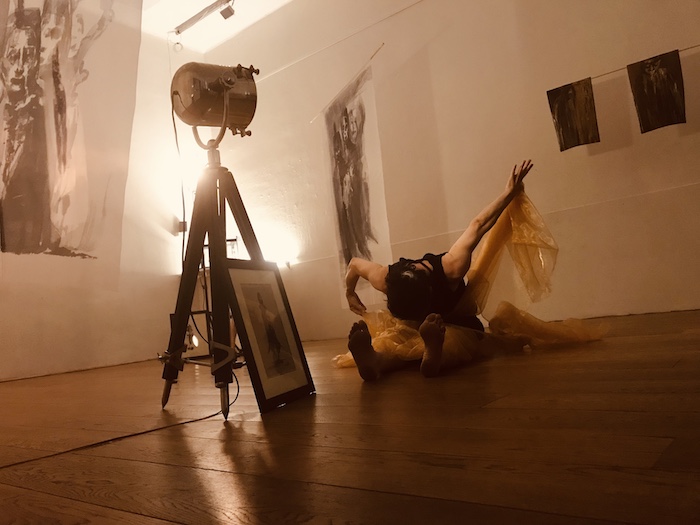
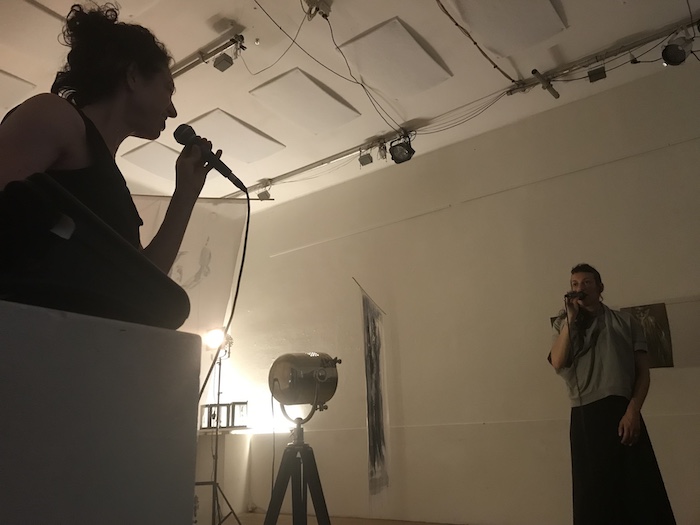
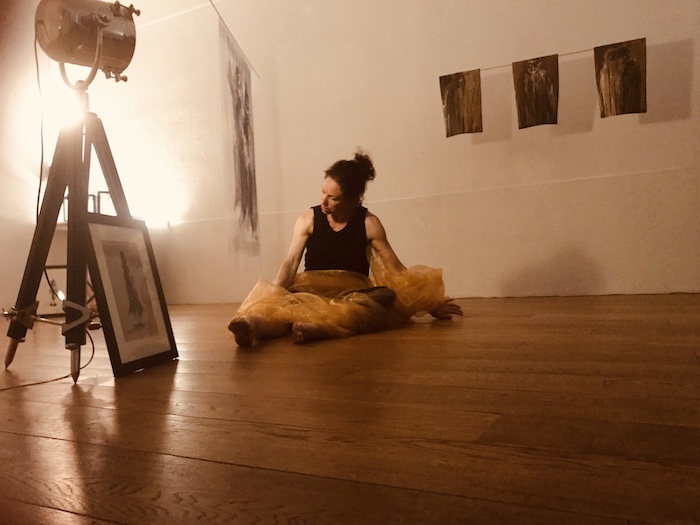
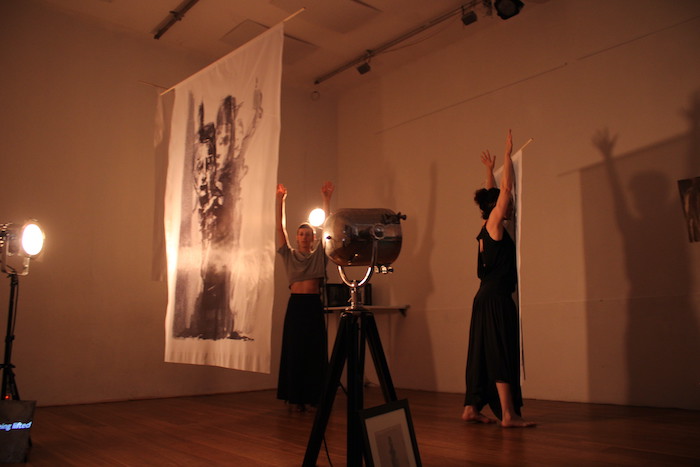
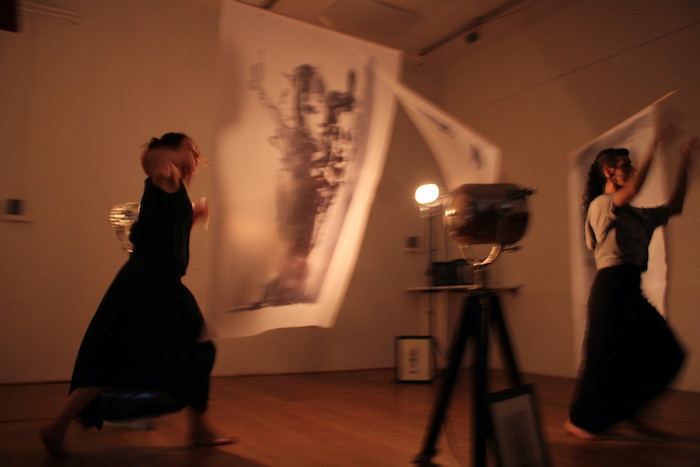
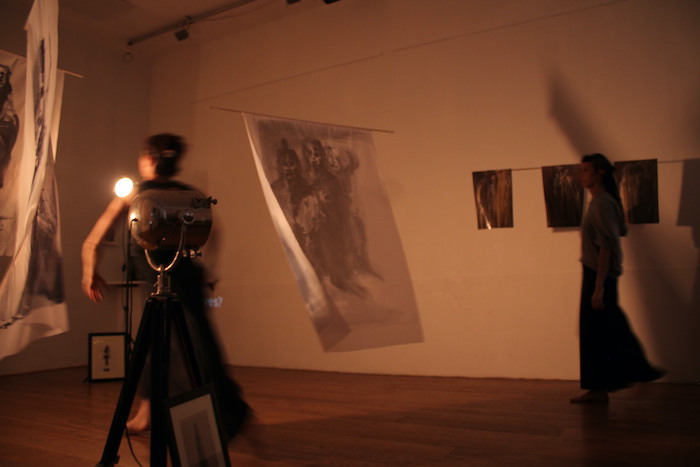
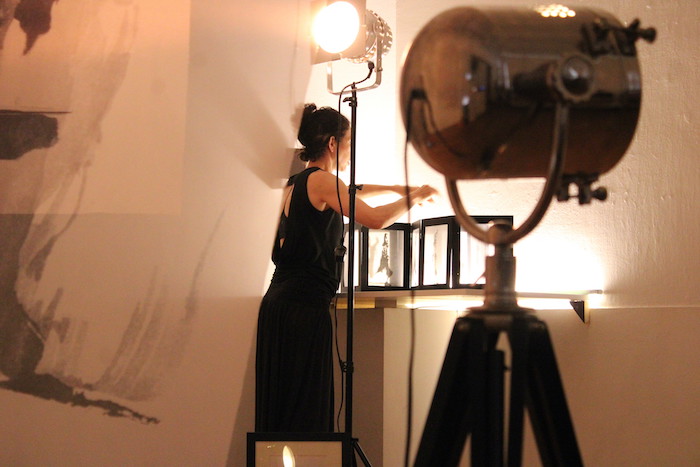
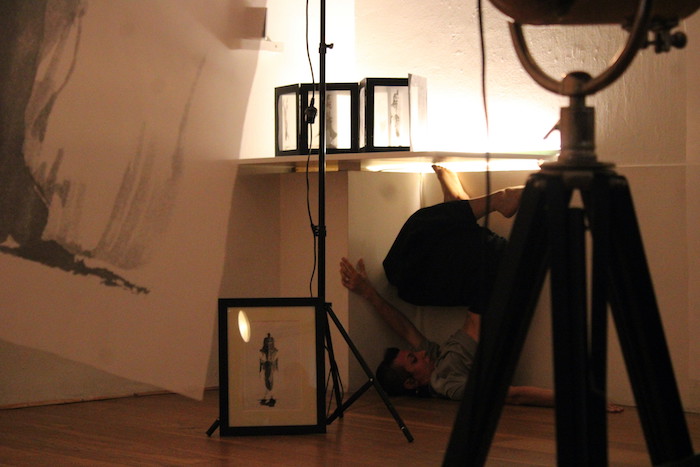
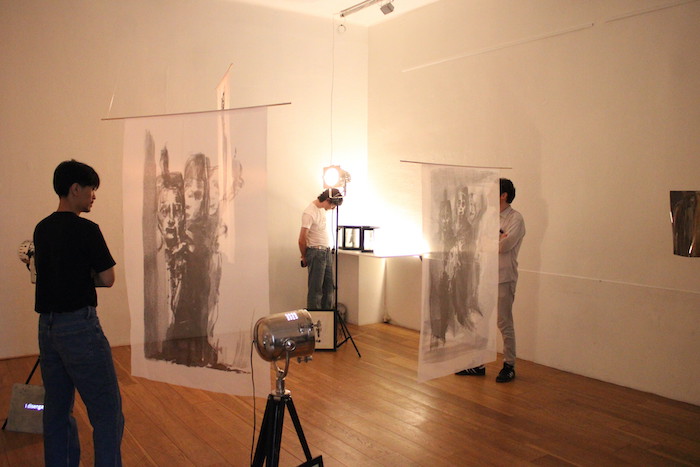
Exhibition and Performance intervention, “Side FX” by gem_n_eye – Irina Baldini (Österberg) and Emily Welther.
Premiered 26.6.2026 at 4bid gallery, OT301 Amsterdam
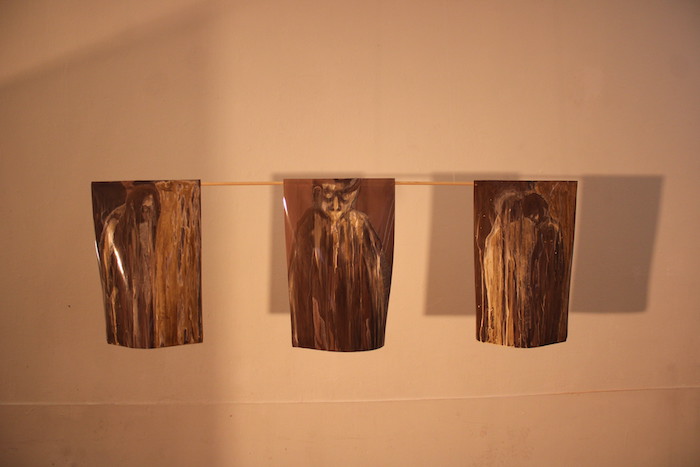
Prints on textile, cyanotypes, ink on paper, chemigrams, by Irina Österberg
Human inter-action – the movements or actions between individuals.
Human intra-action – the movements or actions through and within individuals.
Side effects – the unforeseen responses and consequences that occur when individuals
inter-act.
While human inter-action can provide connection, it can also lead to misinterpretation,
misunderstanding and tendency towards dependency and interdependence. In certain
social contexts, the individual looses of sense of authenticity and their individual agency.
During their study time at 4bid, gem_n_eye look into the side effects of inter-action,
welcoming collisions, encounters, and their inevitabilities through various artistic
mediums.
gem_n_eye create situations and settings using visual art, movement, voice, and sound
to tease out these moments of consequence. Where do we and these mediums overlap,
fade, cross, drip, insist, deviate, reconsider, include, hide …? And what happens on the
side?
Every inter-action carries systemic side effects that are often entirely divorced from our
original intentions. The sociologist and philosopher Robert K. Merton formalized this
with the Law of Unintended Consequences. He argued that human nature, combined
with the sheer complexity of social fabrics, guarantees that our interactions and policy
interventions will yield unanticipated, sometimes perverse side effects.
Are these to be avoided or embraced? What can they reveal when accepted as part of
the decisions we make? Can they become material, artistic or food for thought rather
than source of frustration?
Philosophers point out that socializing forces individuals to compromise their true selves
to maintain harmony. Arthur Schopenhauer argued that society demands mutual
accommodation, requiring people to dilute their ideas and suppress their unique traits.
He believed forced social interaction causes us to sacrifice a significant portion of our
intellectual depth just to be palatable to the masses. Friedrich Nietzsche echoed this
sentiment, cautioning against "herd mentality", warning that constant interaction with the
collective drags exceptional minds down to the level of mediocrity.
Is it possible to meet each other, and tilt to meet the other without tipping over our own
edge and fall outside of our center of gravity?
Language and communication are inherently fragile. Even when we attempt to interact
with pure intentions, the effects of our words often fail to match our goals.
Misinterpretations, semantic slippages and differing psychological backgrounds ensure
that communication contains permanent, unavoidable side effects. gem_n_eye asks:
What inter-actions lead to which side effects? Are they disturbing or do they offer
opportunities that are as yet unrealized? How can we become aware of them in their
multitudes, how can we catch them before they or we fade into the background?
-
-
The others in me
The porosity of my memories
The crowd, the solitude
I disengage
Another veil is being lifted
How to maintain an absence in our lives?
These spaces are where we store our magic, our hope, our longing
I fight with stillness, make the void.
Nothing feels productive
How to cultivate/nourish/nurture our own thoughts?
The void leaves room for the spirits, warning me of my crowded life, if I don’t remember
them, I lose myself
Our own thoughts, our rarest commodity
How to maintain an absence in our lives

